


Head office
SECO Sensor Consult GmbH
Am Bleichanger 1
96450 Coburg
Phone: +49 (0)9561 869 141
Fax: +49 (0)9561 869 149
Email: info@seco-sensor.de
Cryo-electron microscopy (cryo-EM) has become an indispensable tool in structural biology, as it allows researchers to visualize proteins and other macromolecules with near-atomic resolution. However, one of the biggest challenges in sample preparation for cryo-EM is preferred particle orientation. When proteins adsorb at the air-water interface during vitrification, they often deposit in specific orientations, limiting the diversity of views and making it difficult to reconstruct accurate 3D models.
A recent study by EPFL (Ecole Polytechnique Fédérale de Lausanne) presents a novel and elegant solution: continuous ultrasonic excitation during vitrification. This approach uses mechanical vibrations to disrupt the interaction between proteins and the interface, allowing the particles to adopt a wider range of orientations before freezing.
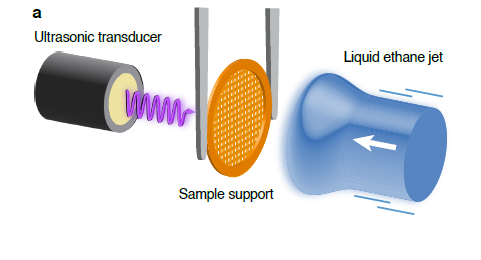
bioRxiv 2025, with kind permission from: Michal Haubner, “Overcoming Preferred Orientation in Cryo-EM With Ultrasonic Excitation During Vitrification”
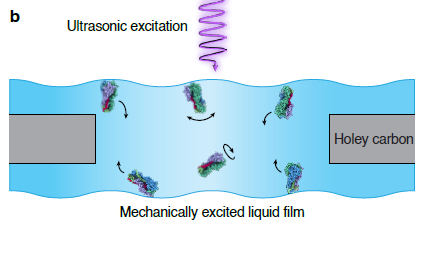
bioRxiv 2025, with kind permission from: Michal Haubner, “Overcoming Preferred Orientation in Cryo-EM With Ultrasonic Excitation During Vitrification”
At the heart of this method is the SECO SC049 ultrasonic transducer, which operates at a frequency of 490 kHz and emits controlled vibrations to the sample holder during vitrification. These vibrations are transmitted through the grid holding the sample and induce subtle movements in the thin film of liquid surrounding the proteins.
These micro-movements generate gentle shear forces that ‘detach’ the proteins from the air-water interface. Instead of settling in their preferred orientation, the particles remain in motion until they are rapidly frozen by a jet of liquid ethane. This process traps them in a more random, non-equilibrium distribution, which significantly improves the quality of the cryo-EM data.
Unlike chemical processes that require surfactants or modified carrier films, ultrasonic excitation is purely physical and non-invasive. It does not alter the composition of the sample and can be easily integrated into existing vitrification workflows. The technique is compatible with both jet vitrification and immersion freezing systems, making it accessible to a wide range of laboratories.
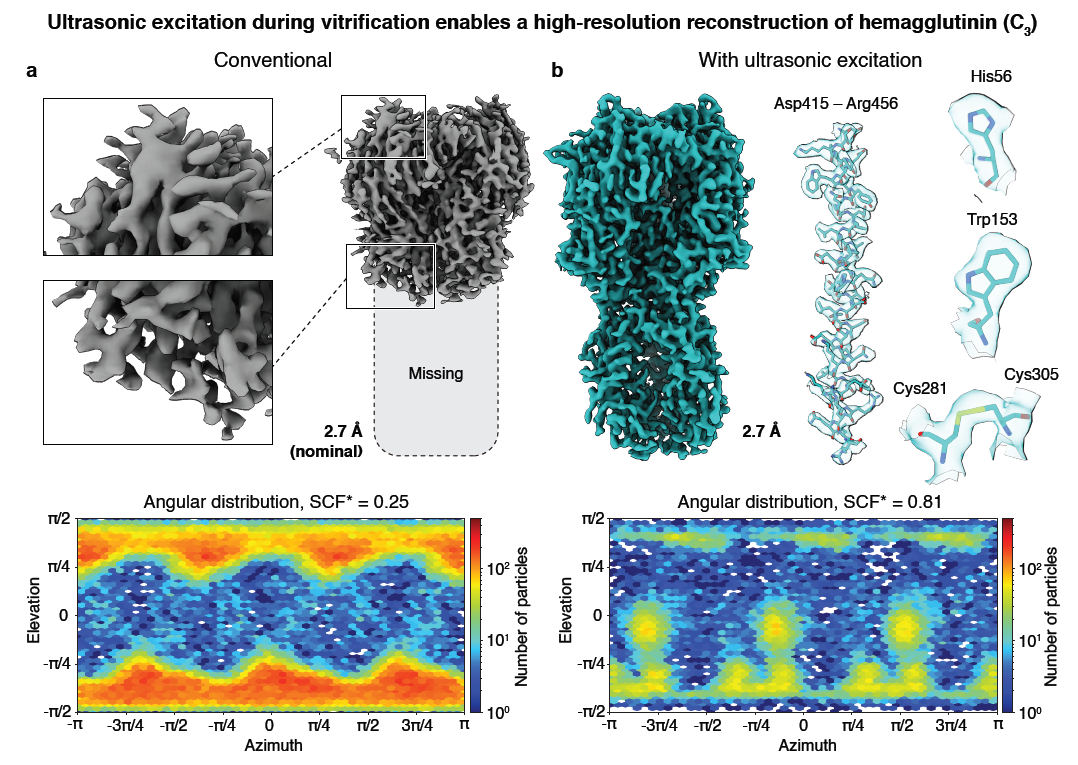
bioRxiv 2025, with kind permission from: Michal Haubner, “Overcoming Preferred Orientation in Cryo-EM With Ultrasonic Excitation During Vitrification”
Preferred orientation has long been a bottleneck in cryo-EM, especially for small or symmetrical proteins. By solving this problem with a simple physical principle, ultrasonic excitation opens up new possibilities for high-resolution imaging and more reliable structural analysis.
This breakthrough demonstrates how SECO’s ultrasonic technology enables cutting-edge research in structural biology. By overcoming one of the biggest limitations of cryo-EM, the SC049 transducer plays a key role in advancing high-resolution imaging of complex biomolecules.
Our product manager Stefan Schneider will be happy to advise you on our smallest ultrasonic transducer, the SC049. With a size of only 6 x 5 millimetres, it is perfect for numerous industrial applications – but also for complex challenges in laboratories and science.
On request, we can customise our SC049 to your individual measurement task and modify, for example, the housing, contacts or additional equipment.
Talk to us! We look forward to your inquiry.

Product manager
SECO Sensor Consult GmbH
Am Bleichanger 1
96450 Coburg
Phone: +49 (0)9561 869 141
Fax: +49 (0)9561 869 149
Email: info@seco-sensor.de

 SECO Sensor at Sensor+Test 2026
You need to load content from reCAPTCHA to submit the form. Please note that doing so will share data with third-party providers.
More Information