


Head office
SECO Sensor Consult GmbH
Am Bleichanger 1
96450 Coburg
Phone: +49 (0)9561 869 141
Fax: +49 (0)9561 869 149
Email: info@seco-sensor.de
To prevent icing on the front surface and ensure reliable measurement even at temperatures close to and below freezing, we equip our ultrasonic transducers with optional transducer heating. The heating element prevents the transducer from freezing and prevents the accumulation of frost, snow, and ice. For many of our customers in the field of anemometry, the installation of heating is now standard equipment.
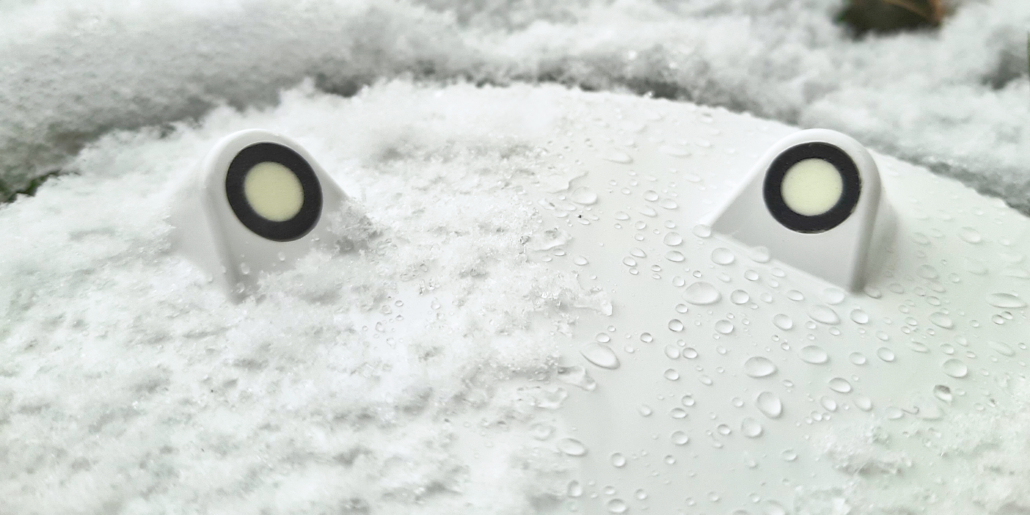
In the following experiment, on November 29, 2023, two identical SC031 transducers, one without heating (left) and one with heating (right), were installed in an anemometer on an outdoor test bench and electrically connected. After the first snowfall, a clear difference in the surface condition of the two samples can already be seen. While the snow accumulates in the area without heating, it thaws directly on the transducer with heating. It is also noticeable that the heating not only warms the transducer, but also a larger area around it.
Over the course of a week and after further snowfall with sustained temperatures between -9°C and 0°C, the difference between the two samples becomes even more apparent. While the transducer without heating is covered by a layer of snow several centimeters thick, the transducer with heating has melted away a larger area of snow. This enables continued reliable measurement and the above-mentioned reliable protection against icing and covering of the front surface.
Do you also need a heater? Talk to us.

SECO Sensor Consult GmbH
Am Bleichanger 1
96450 Coburg
Phone: +49 (0)9561 869 141
Fax: +49 (0)9561 869 149
Email: info@seco-sensor.de

 Colored transducers
You need to load content from reCAPTCHA to submit the form. Please note that doing so will share data with third-party providers.
More Information